Intentionality and the soft fabric of agentic code
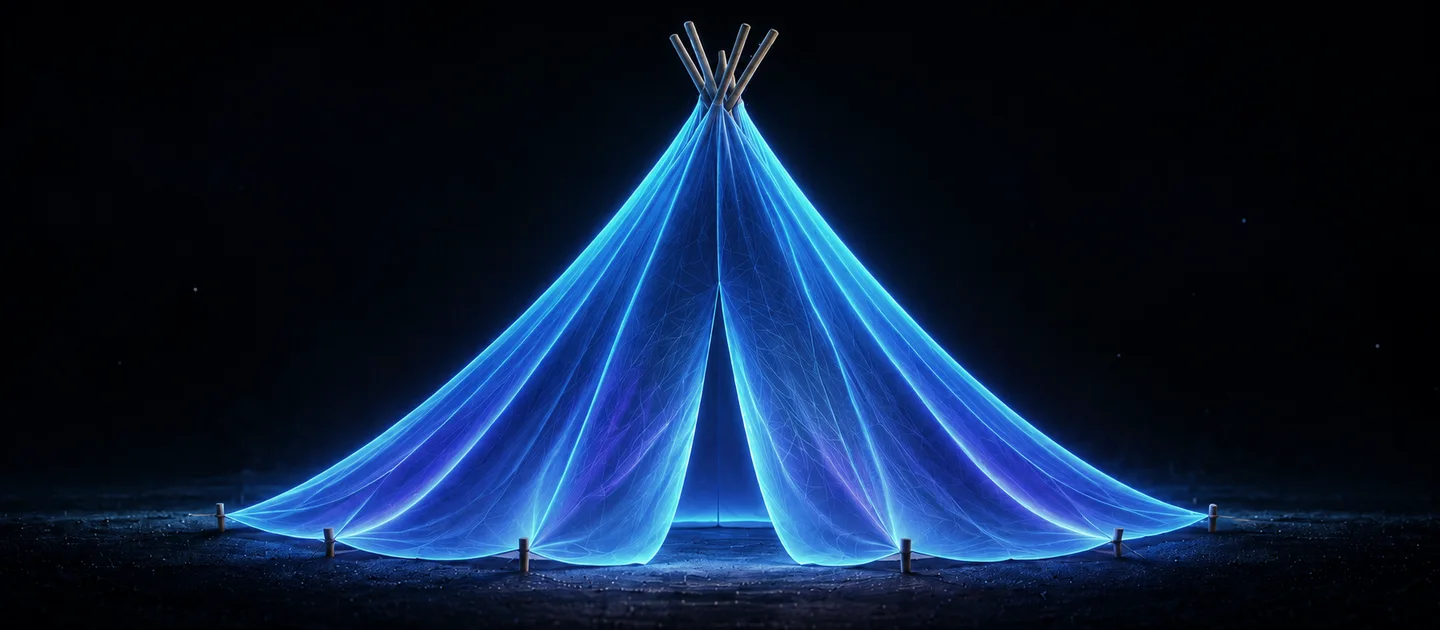
Agentic code can be thought of as a fabric. It is easily shaped and can assume any form with little effort, but it is hard to build something rigid out of it. While agents can produce brilliant snippets of code at the level of human experts, cohesion and consistency remain a challenge.
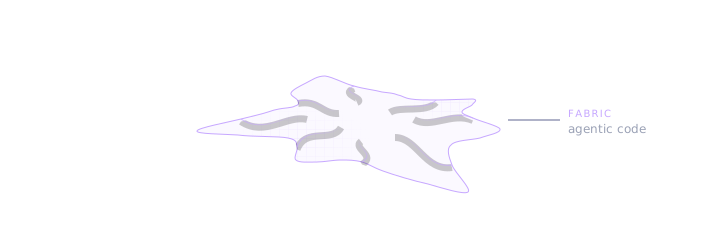
The peg fallacy
There is a real problem with the softness of fabric alone. A natural inclination is to address the lack of structure in agentic workflows by adding tests, contracts, static analysis and agent harnesses. However, pinning down the edges with pegs does little to enforce internal structural rigidity. Without an internal structure to apply the constraining forces upon we are still in a soft, flat mess.
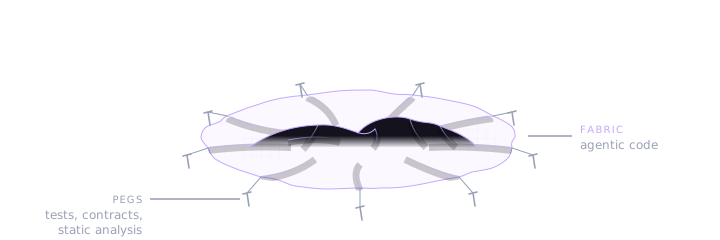
Building a tipi
We'd be helped by sturdy poles to stretch the fabric into its desired shape. In software terms - a distinct architecture by which all additional work is guided and upon which the tests and static analysis apply constraining forces. In a tent, there is a symbiotic relationship between the internal structure, the fabric and the pegs. Software is much the same. Without an architecture to stretch the web of features across, the constraining pegs are of little use. Without the pegs, on the other hand, we might wake up in the morning with all of the wooden structure in place, but the fabric in a tree top far away.
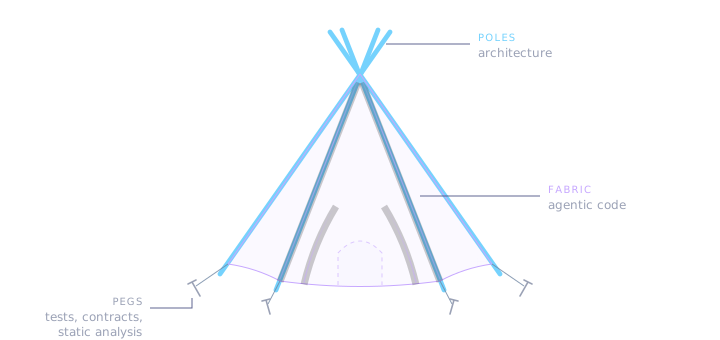
That's the theory. Here is how it played out on my project.
A thousand doubts
In the early summer of 2025 I started building Epiq, an issue tracker that keeps its state in the repository and syncs over Git.
Back then agentic workflows were but distant rumors. The architecture was forged in manual struggle with the code, endless rubber ducking, 11h meditation sessions (road trips) and a thousand doubts.
Trees in the forest of ideas were selected, pruned of false branches, logged, sharpened, and finally knit together. In the end, a few non-negotiable architectural poles emerged:
- User-scoped, append only event logs for persistence
- Events with CRDT-like properties, only referencing shared history
- Causal order resolution, tie-broken by ULID
Upon these rests every later feature.
Constraints over slop
None of these is exotic on its own, but together they are not a mainstream solution. Had the workflow been 100% agentic, this architecture would have been an unlikely outcome, since probabilistic models punish anything unorthodox.
The solution becomes more likely when revealing the constraints:
- The board lives in the repo with the code (no server, vendor-agnostic)
- Git is the only transport
- Users are never asked to resolve merge conflicts
- Several people, and agents, might edit at the same time, on- or offline
These constraints were derived from a human vision. Novelty is unlikely when not guided by constraints, and without a vision, no constraints are given.
Agents lacking a vision for the codebase is why, if you ask for a red button, and then for a blue button, you might get two different button components rather than a single configurable button.
Pinning it down
Once the poles were in place, post launch in summer 2026, a fabric factory opened its gates a meter away. Enter Claude Code. Introduced any earlier, it might have been to the detriment of the architecture. As it was, the agents arrived at the precise moment when a fabric of features had a frame to stretch across.
Suddenly not only features were cheap, but tests too. You could add a thousand tent pegs for a single pole, firmly pinning it to the ground. The core is now pegged down with paranoid tests trying to break the concurrency model or the Git interactions. One test simulates a team of 20 using the tracker intensely every day for 10 years, verifying the board is still usable and responsive at scale.
We live in an age where pegs are cheap, allowing us to lock the architecture firmly in place.
The great inversion
The observant reader might have noticed that there is a common denominator between all of the foundational poles in this project. They are all concerned with the data model.
A common notion is that data is soft and software is rigid. Agentic workflows have challenged, one might even say, inverted, this perceived relationship. What has not changed, however, is the cementing effect data has on a system. Data comes with migrations, uncharted sources, varying quality, risky transformations, all of which are petrifying to system evolution.
Picking the right data model is not an afterthought, but a core feature of the architecture. Poles to stretch the soft tissue of code across, nailed to the ground with tests.
On this project, the data model has proven not only essential for distributed live collaboration, but has also resulted in an evolvable system. So far every new feature has been added by deriving information from the logs in a new way or by adding another event type, never by migrating existing data. When image attachments were added, for instance, all it took was another event type, which newer clients recognized, and older ones ignored. When advanced statistics were added, it was a matter of identifying derivable insights from the event log.
Not all systems live under the same constraints, and other visions call for other structural poles. In any event, one can expect the data model to outlive the code, and as such it must be considered a part of the load-bearing structure.
The aimless factory
A massive amount of effort is going into setting up loops, harnesses and software factories, but little attention seems to be given to intentionality and vision. In the real world there are factories that overproduce to justify their existence because they are static, massive units built for predicted demand that never materialized. And so they produce high-quality garbage that no one wants. This happens in software too, which I can attest to first-hand (but that's another story).
Sometimes you just need an axe, a few trees and a skilled craftsman. Intention, comprehension and vision beat big, aimless factories.
Back to the tipi
Agentic workflows can help us wrap up our framing in beautiful ornaments in no time and help us pin it firmly to the ground with a thousand pegs, but without well-understood, sturdy poles of architecture, we have nothing but a soft, formless mess. Ornate, but flat, wet and tangled.
The art of not writing all the code is knowing which parts you must build intuition for, starting from a vision, deriving the constraints, and raising the poles.
Does this resonate with you, or do you disagree? Please share your thoughts below.